

- This event has passed.
CME Dinner – Nashville
September 24 @ 6:00 pm - 8:00 pm
Free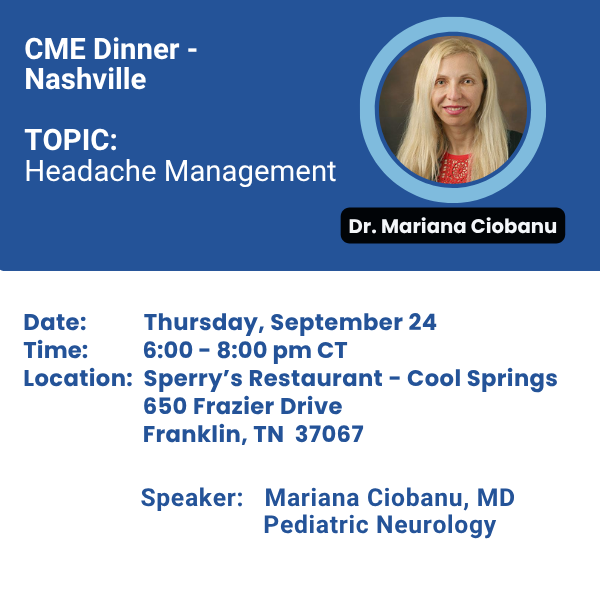
Join us for a CME Dinner in Franklin!
Led by Pediatric Neurologist, Dr. Mariana Ciobanu, this session will provide CME credit and will cover headache management for pediatricians and primary care providers and when to refer pediatric patients to Neurology. The dinner will take place at Sperry’s Restaurant in Cool Springs.
Mariana Ciobanu, MD
Associate Professor of Pediatric Neurology, Medical Director – Division of Pediatric Neurology,
Department of Pediatrics – Monroe Carell Jr. Children’s Hospital at Vanderbilt
Title: Migraine Management in Children
Summary: Pediatric migraine affects approximately 11% of children and adolescents and remains a significant cause of missed school, impaired academic performance, and reduced quality of life. This presentation reviews current evidence-based approaches to acute and preventive migraine management, including guideline-recommended use of NSAIDs and triptans, the role of lifestyle modifications, and the integration of behavioral strategies such as cognitive behavioral therapy. Participants will also explore emerging advances in migraine prevention, including newly approved CGRP-targeted therapies and evolving expert recommendations for their use in pediatric and adolescent populations. Special attention will be given to the challenges of preventive treatment, recent clinical trial findings, and practical considerations for tailoring care to reduce disease burden and improve outcomes for young patients.
Objectives:
1. Identify first-line acute treatments for pediatric migraine per the 2019 AAN/AHS guideline, including ibuprofen, acetaminophen, and FDA-approved triptans, and apply appropriate route-of-administration selection based on attack characteristics.
2. Recognize the limitations of traditional preventive pharmacotherapy in children, including the high placebo response rate and the lack of superiority of topiramate and amitriptyline over placebo in the CHAMP trial.
3. Describe the role of biobehavioral interventions — including CBT, biofeedback, relaxation techniques, and lifestyle modifications — as integral components of a comprehensive pediatric migraine management plan.
4. Evaluate the emerging evidence for CGRP-targeted therapies in pediatric migraine, including the phase 3 fremanezumab trial demonstrating FDA approval for episodic migraine prevention in children aged 6–17, and the criteria for selecting appropriate candidates.
5. Discuss ongoing pediatric clinical trials and future directions for novel migraine therapies including anti-CGRP monoclonal antibodies, gepants, and ditans, and their potential to reshape the pediatric migraine treatment landscape.
Make plans to join us for this important discussion and the opportunity to network with colleagues.